
Node
Contact for Pricing
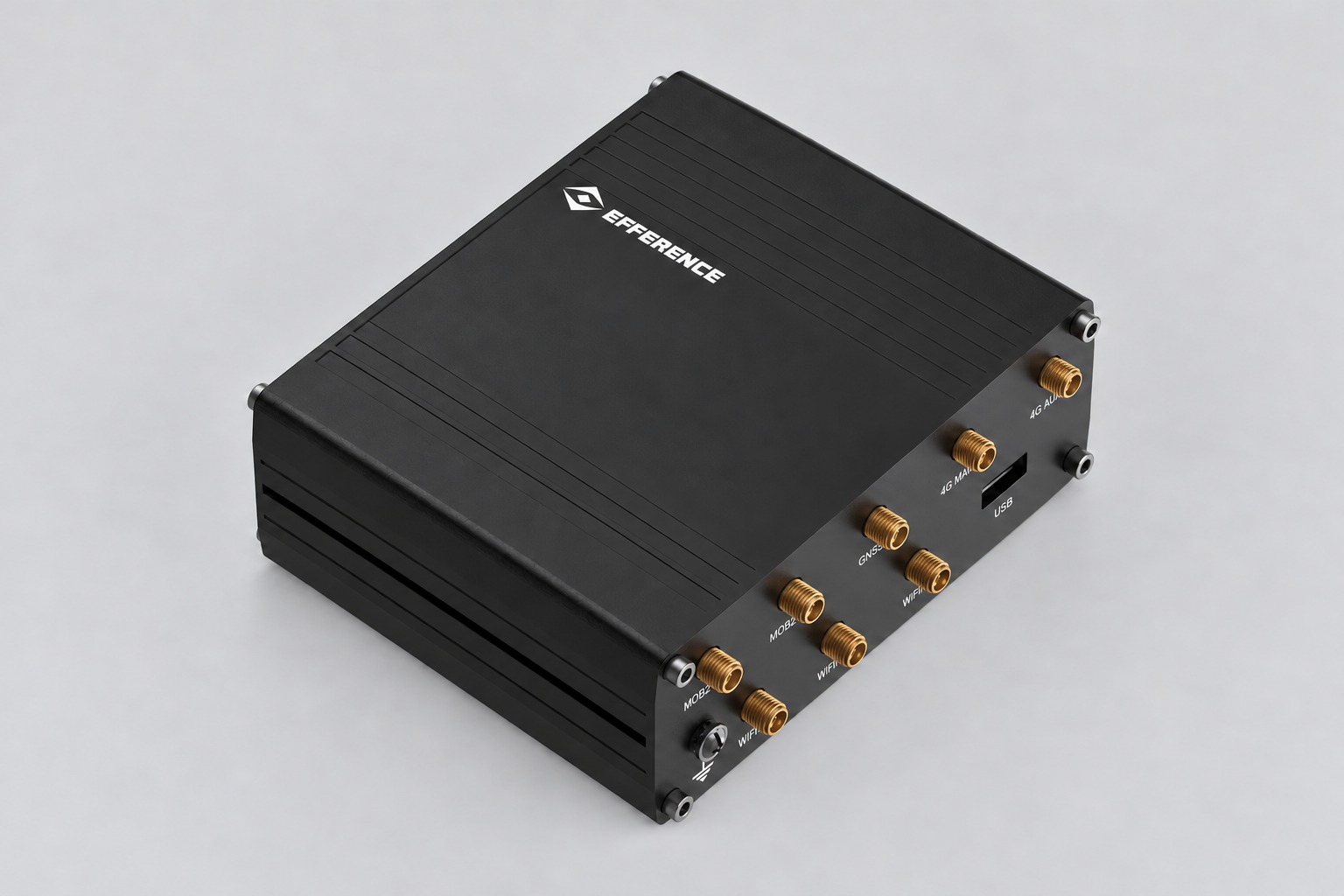
Designed for the multi-path uplink, for uploads and deployments. It combines Wi-Fi 7 networking with 5G connectivity. It connects Mono and Stereo observation streams to shared compute, from the home to the factory.
Features
- Scheduled uplink for camera and teleoperation traffic.
- Multi-client connectivity with admission control.
- 5G backhaul and Wi-Fi 7 networking.
- A shared SDK with Mono and Stereo for synchronized observation streams.
Applications
- Scheduled wireless uplink for robots.
- Connectivity for multi-robot fleets.
- Home and factory deployments.
- Streaming time-aligned observations to shared compute.
Technical specifications
Configuration
Wi-Fi 7 access point with 5G Sub-6 GHz backhaul, multi-gigabit Ethernet, and OpenWrt.
System
- Processor
- 64-bit ARM Cortex-A73 at 2.2 GHz
- Memory
- 1 GB DDR4
- Storage
- 4 GB eMMC
- OS
- OpenWrt (Linux)
Wireless
- Standard
- Wi-Fi 7; IEEE 802.11a/b/g/n/ac/ax/be
- Bands & MIMO
- 2.4, 5, and 6 GHz support; 2 × 2 MU-MIMO
- Channel widths
- 20, 40, 80, 160, and 320 MHz, depending on band and configuration
- Peak PHY rates
- Up to 688.2 Mbps at 2.4 GHz, 4.324 Gbps at 5 GHz, or 5.765 Gbps at 6 GHz. Per-band radio limits, not additive throughput.
- Radio features
- 4096-QAM and multi-link support; availability depends on firmware and client support
- RF connections
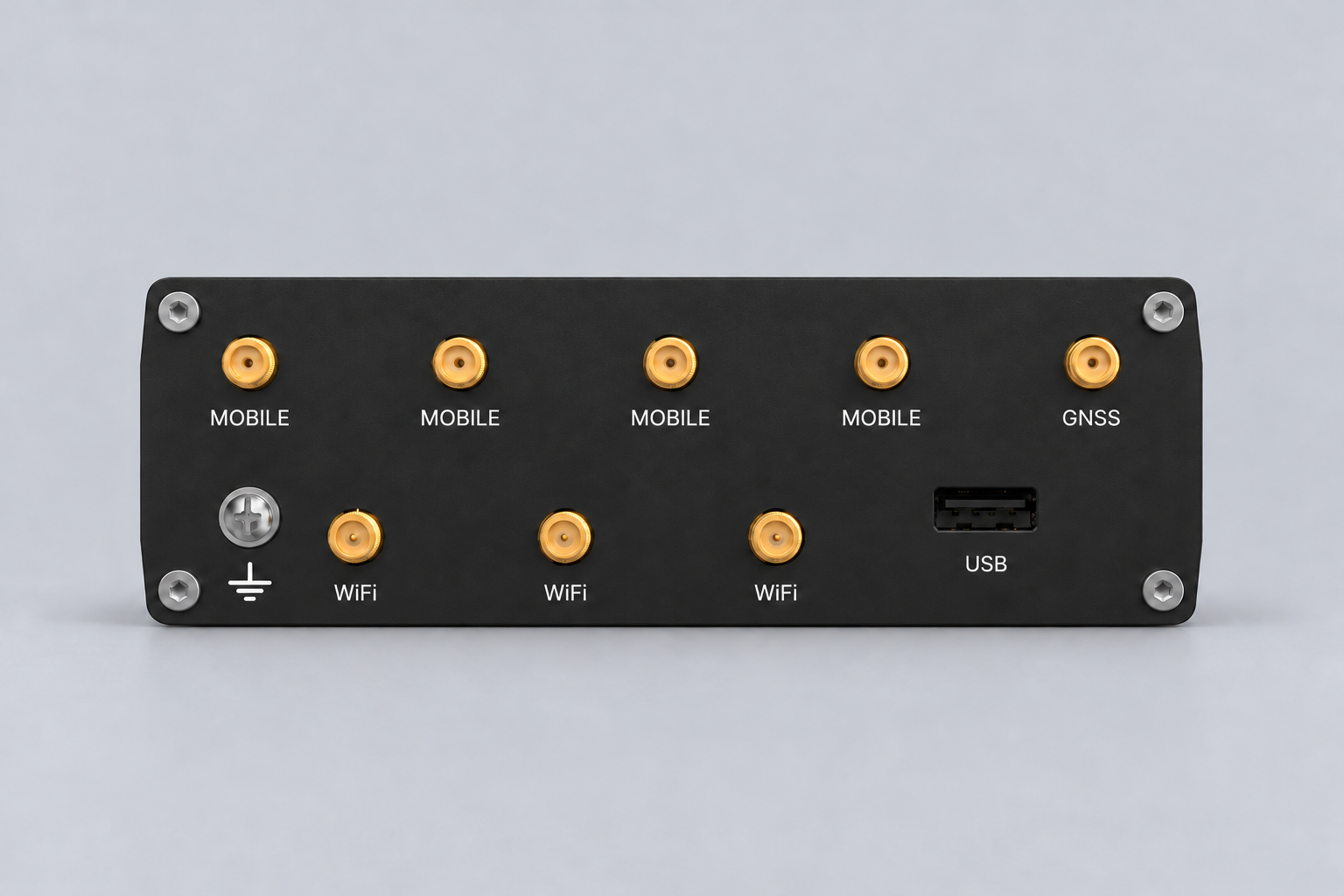
- 4 Wi-Fi antenna connections; 2 × 2 MIMO
Mobile
- 3GPP
- Release 17; 5G NR SA / NSA, with LTE and WCDMA fallback
- 5G SA, Sub-6 GHz
- Up to 7.01 Gbps downlink / 1.25 Gbps uplink
- 5G NSA, Sub-6 GHz
- Up to 5.47 Gbps downlink / 730 Mbps uplink
- 5G NSA, mmWave (optional)
- Up to 9.41 Gbps downlink / 3.66 Gbps uplink with mmWave antennas
- Cellular MIMO
- Sub-6 GHz: up to 4 × 4 downlink and 2 × 2 uplink on supported bands
- LTE
- Cat 20 downlink / Cat 18 uplink; up to 2 Gbps downlink / 211 Mbps uplink
- WCDMA
- Up to 42 Mbps downlink / 5.76 Mbps uplink; B1, B2, B4, B5, B8, B19
- 5G NR bands
- n1, n2, n3, n5, n7, n8, n12, n13, n14, n18, n20, n25, n26, n28, n29 (receive only), n30, n38, n40, n41, n48, n53, n66, n70, n71, n75, n76, n77, n78, n79, n91, n92, n93, n94; mmWave n257, n258, n260, n261. Supported combinations depend on SA/NSA mode, firmware, antennas, and operator.
- LTE bands
- FDD: B1, B2, B3, B4, B5, B7, B8, B12, B13, B14, B17, B18, B19, B20, B25, B26, B28, B29, B30, B32, B66, B70, B71. TDD: B34, B38, B39, B40, B41, B42, B43, B48, B53. LAA: B46 (receive only).
- SIM interfaces
- 2 × (U)SIM interfaces, 1.8 / 3.0 V; optional eSIM
- GNSS (optional)
- GPS, GLONASS, BeiDou, Galileo, and QZSS
- Modem integration
- USB 2.0 / 3.0 / 3.1 and single-lane PCIe; 3GPP TS 27.007 AT commands
Interfaces
- Ethernet interfaces
- 2 × USXGMII / 10GBase-R / SGMII+ / SGMII, plus 1 × USXGMII-M / PSGMII / QSGMII / SGMII+ / SGMII
- External network ports
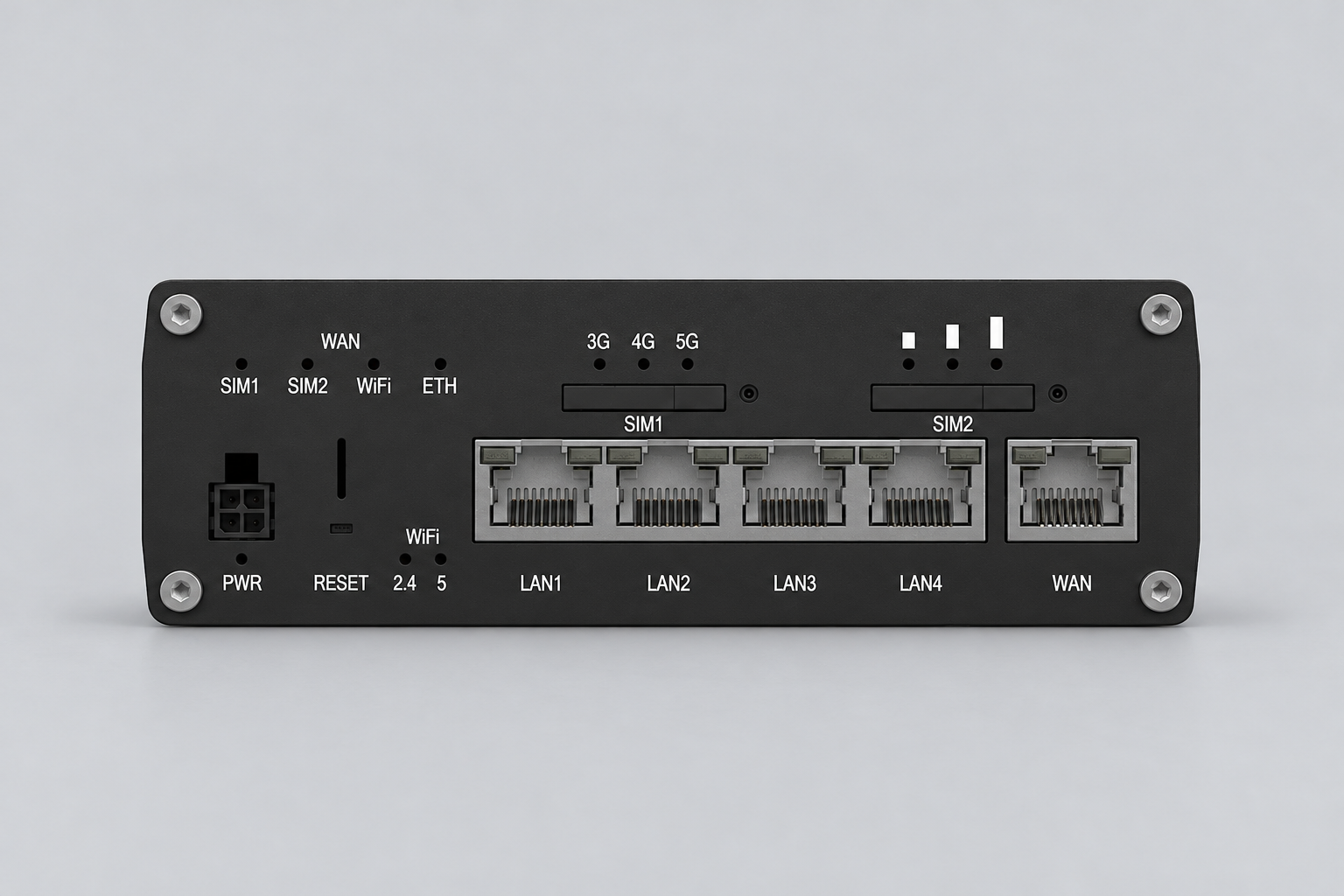
- 1 × 10 GbE RJ45; 1 × 2.5 GbE RJ45; 1 × SFP port
- USB
- 1 × USB 3.0
- PCIe
- PCIe 3.0; 2 × single-lane and 1 × dual-lane interfaces
- Serial & I/O
- UART, SPI, I²C, I²S, PWM, and 34 GPIOs
Power
- Networking supply
- 3.3 V at the networking module; 12 W consumption
- Modem supply
- 3.135–4.4 V at the cellular module; 3.7 V typical
- Power input
- 12 / 24 V DC or USB-C Power Delivery; 48 V passive PoE on the 2.5 GbE port
Physical & environment
- Networking module
- 38.3 × 61.7 mm; 20 g; solderable LGA
- Cellular module
- 52.0 × 30.0 × 2.3 mm; approximately 8.73 g; M.2
- Networking temperature
- 0 to 65 °C
- Modem temperature
- Operating: −30 to 75 °C. Extended range: −40 to 85 °C; these are module ratings.
Specification notes
Radio rates are theoretical module limits. Actual performance depends on the host interface, firmware, antennas, clients, spectrum, and network conditions. Band availability varies by region and operator.